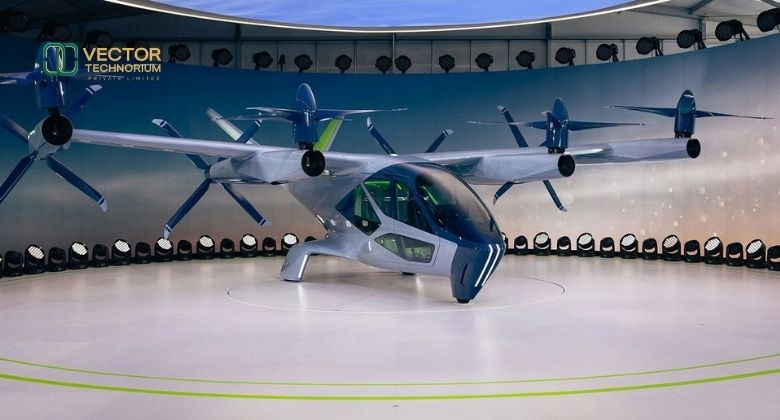
Urban Air Mobility is moving from concept decks to certification programs, pilot routes, and infrastructure procurement. The next bottleneck is not only the aircraft. It is the ecosystem around it, especially vertiports.
Here is the hard truth most teams discover late: you cannot “add” vertiports after the eVTOL is defined, and you cannot finalize an eVTOL without understanding the vertiport it will actually use. The winners will design both together as a coupled system, balancing performance, safety, noise, energy, passenger flow, and operations.
This is where a consultancy like Vector Technorium can create genuine leverage. Very few firms can speak with authority across aircraft constraints, infrastructure engineering, certification logic, and day-to-day operations. In practice, that cross-domain competency determines whether a vertiport becomes a scalable node in a network or an expensive prototype that never expands.
This article breaks down how the next generation of vertiports should be designed in parallel with eVTOL aircraft, and what technical decisions matter most.
Why “co-design” is the only viable approach
A vertiport is not a helipad with chargers. It is a transportation terminal with aviation-grade safety layers, energy infrastructure, turnaround targets, and noise constraints, often located in the most complex parts of a city.
The aircraft, meanwhile, is not just a vehicle. It is a collection of constraints that the vertiport must respect:
- Performance envelope: takeoff and landing profiles, hover capability, climb gradients, abort procedures.
- Energy behavior: battery capacity, thermal conditioning, charging rate limits, turnaround energy needs.
- Noise signature: frequency content, tonal components, trajectory sensitivity, operational noise mitigation tactics.
- Mass and balance: passenger count, baggage assumptions, reserves, and weather penalties.
- Maintainability: line checks, component access, fault diagnostics, and spares handling.
If vertiport planners lock the pad layout, approach paths, or energy system too early, the aircraft may fail to meet turnaround time, noise limits, or regulatory acceptance. If aircraft teams optimize without the reality of rooftop loads, fire codes, and grid constraints, they end up with vehicles that are operationally fragile.
Co-design means making decisions using the same shared operational model: target routes, weather, demand peaks, turnaround times, noise corridors, emergency cases, and staffing assumptions.
Start with the operating concept, not the architecture diagram
Most vertiport designs fail because they begin with a beautiful site plan rather than a validated Concept of Operations (ConOps).
A credible ConOps answers questions like:
- What are the initial routes, and how do they expand over time?
- What is the mission profile (distance, reserves, alternate landing expectations)?
- What are the peak-hour arrivals and departures, and what reliability target is required?
- Will the vertiport support single operator or multiple fleets?
- What is the assumed turnaround time: passengers off, inspection, cleaning, charging, boarding?
- What happens during weather degradation, temporary pad closure, medical diversion, or aircraft fault?
- How many movements per hour are expected on day one, year three, and year ten?
The reason this matters is simple: every major subsystem, from gate count to charger sizing, is a derivative of ConOps. Without it, “future-ready” becomes a synonym for overbuilt and underutilized.
Site selection is an aircraft performance problem in disguise
Vertiport location is often framed as a real estate and zoning problem. In reality, it is also an aircraft capability and noise problem.
Key co-design factors:
Obstacle environment and approach geometry
eVTOLs need defined departure and arrival corridors that respect obstacle clearance, safe landing areas, and contingency paths. Building height, cranes, and dynamic obstacles (like construction zones) matter.
Design implication:
- Pick sites where approach/departure paths can be protected or negotiated early.
- Avoid locations where trajectories force steep profiles that increase noise or energy consumption.
Rooftop structural constraints
Rooftops look available on a map until you calculate point loads, dynamic loads, vibration, and reinforcement cost.
Rooftops look available on a map until you calculate point loads, dynamic loads, vibration, and reinforcement cost.
Design implication:
- The aircraft’s landing gear footprint, maximum takeoff weight, and touchdown dynamics directly influence required structural upgrades.
- Standardizing pad structural interfaces can reduce retrofit complexity across a network.
Microclimate and wind complexity
Rooftop turbulence, downdrafts, and heat plumes can impact stability margins and passenger comfort.
Design implication:
- Match aircraft control authority and gust tolerance to the site’s wind environment.
- Use CFD-informed architectural features (screens, parapets, flow conditioners) where needed.
Pad design: beyond dimensions, think in procedures and contingencies
A next-generation vertiport pad is defined as much by procedures as by concrete markings.
Co-design questions that must be answered together:
- Can the aircraft perform a precision landing with the expected navigation stack and sensor performance?
- What is the abort strategy: rejected landing, go-around, hover hold, diversion?
- What is the FATO and TLOF sizing logic under real operational margins?
- How is the safe landing area managed for passenger movement and emergency response?
Practical design implications:
Standardized geometry, adaptable interfaces
A network scales when pad geometry is standardized. At the same time, the interface must accommodate different eVTOL footprints and rotor/prop wash characteristics.
A smart compromise is to standardize:
- touchdown zone geometry and markings
- approach lighting and guidance
- communications and surveillance integration points
- charger positioning envelopes
- emergency equipment placement
Surface materials and wash management
Downwash and outwash can create debris hazards, noise reflection, and passenger discomfort.
Design choices include:
- low-FOD surfacing
- protected drainage systems
- careful placement of loose items, signage, and barriers
- wind-aware fencing that avoids creating turbulence
Turnaround time is the new gate utilization metric
In commercial aviation, gate planning is a mature discipline. Vertiports must reach similar maturity, but with one added constraint: energy.
The economic viability of eVTOL routes depends heavily on how many flights per aircraft per day can be achieved without degrading batteries or stressing operations.
A turnaround model typically includes:
- passenger disembark and embark
- baggage handling assumptions (if any)
- quick external visual checks
- cabin reset and sanitization
- charging or battery swap (if applicable)
- dispatch release and digital logging
The vertiport must be designed to support this flow with minimal crossing paths and minimal idle time. That requires:
- right-sizing of stands, staging areas, and passenger processing
- clear separation between airside and landside
- efficient staff movement and equipment storage
- digital integration that reduces manual coordination
Charging infrastructure is not an add-on, it is the backbone
Battery-electric eVTOLs turn energy infrastructure into a first-class design driver. Define energy strategy early: charge, swap, or hybridize
- Fast charging: simpler logistics but heavy grid demands, thermal constraints, and potential queueing.
- Battery swap: faster turnaround but requires storage, safety handling, standardization, and higher capex.
- Hybrid solutions (range extenders or distributed energy): may reduce peak loads but complicate maintenance and emissions profile.
Design to peak demand, not average demand
Vertiport energy systems must survive the worst hour, not the average day. Peak scheduling often coincides with peak building demand in cities.
Key design steps:
- build a load profile tied to ConOps: arrivals per hour, dwell time, charge power, HVAC loads, lighting, and auxiliary systems
- model queuing: what happens when a flight is late and another arrives early?
- evaluate utility constraints: transformer capacity, service upgrades, permitting lead times
- consider on-site buffering: stationary batteries, flywheels, or microgrids to shave peaks
Thermal management and safety
High-power charging generates heat and introduces fire risk considerations.
Design implications include:
- dedicated ventilation paths for charging zones
- compliant fire detection and suppression strategy
- clear emergency isolation procedures
- separation between passenger spaces and high-energy equipment
Safety engineering must bridge aviation and building codes
Vertiports sit at the intersection of aviation regulations, building codes, fire codes, and local planning rules. Many projects get stuck because teams treat these as sequential approvals. They are not. They are coupled constraints.
A next-generation vertiport design should implement a safety case that addresses:
- ground operations hazards (FOD, rotor wash exposure, jet blast equivalent effects)
- lithium battery risks (thermal runaway, smoke management, isolation zones)
- passenger management (crowd control, unauthorized access, panic scenarios)
- emergency response (fire service access, egress capacity, injured passenger handling)
- system failures (power loss, comms loss, navigation aid degradation)
- cybersecurity (charging systems, scheduling systems, access control)
The key is building a clear hazard analysis and translating it into design requirements early, including physical barriers, redundancies, and operating procedures.
Noise is a design variable, not just a compliance checkbox
Noise will decide where vertiports can exist, how many movements they can support, and what hours they can operate. Unlike helicopters, many eVTOL concepts can reduce perceived noise, but only if trajectories and operations are designed with noise in mind.
Co-design levers include:
- Trajectory shaping: avoiding low-altitude high-power segments over sensitive areas.
- Approach speeds and descent profiles: balancing energy use and tonal noise.
- Pad placement and shielding: using the structure itself to block line-of-sight noise in certain directions.
- Operational scheduling: limiting high-frequency operations at night.
- Fleet matching: assigning quieter aircraft variants to noise-sensitive nodes.
The vertiport should include a noise monitoring plan and feedback loop that informs operational adjustments. Cities will increasingly expect measurable performance, not just promises.
Passenger experience must be engineered like an airport, scaled like a metro station
If the goal is mass adoption, the passenger journey has to feel safe, clear, and quick.
Design the experience around three principles:
Frictionless identity and security flow
Depending on jurisdiction and operator model, security may range from minimal screening to structured checks. Regardless, vertiports should be designed for:
- predictable processing times
- clear wayfinding
- accessibility compliance
- separation of arriving and departing passenger flows
Seamless intermodal connectivity
The vertiport is not the origin or destination. It is a link. Prioritize:
- curb management for ride-share and taxis
- integration with rail, metro, and bus
- protected pedestrian access
- minimal transfer distance and intuitive navigation
Comfort within short dwell times
People will not wait 45 minutes in a premium lounge for a 12-minute flight. The space should support short dwell times efficiently:
- compact, high-clarity layouts
- real-time updates
- basic amenities sized to peak demand, not luxury assumptions
Digital systems are the hidden differentiator
Two vertiports can look similar physically and perform completely differently operationally. The difference is usually software and data integration.
Next-generation vertiports need digital capability across:
- scheduling and slot management
- turnaround tracking and dispatch release
- charging management and load control
- maintenance events and fault reporting
- passenger flow and notifications
- surveillance, access control, and cybersecurity monitoring
The design should anticipate interoperability. In a multi-operator future, proprietary closed systems will become a constraint. Open interfaces and well-defined data contracts matter.
Design for scalability: modularity beats monument-building
The first wave of vertiports must operate before the market is fully proven. That means infrastructure should be expandable in modules.
Scalability strategies include:
- Modular stands and gates: expand from one pad to multiple pads without redoing circulation.
- Expandable energy backbone: oversize conduits and switchgear pathways even if chargers are added later.
- Phased construction plans: minimize downtime while adding capacity.
- Standard kit-of-parts: repeatable designs that reduce cost and approval time across sites.
A scalable vertiport is not necessarily the largest. It is the one that can move from 10 movements per day to 200 without redesigning the entire system.
Certification and standards: design to what will be enforced, not what is convenient
Vertiport standards are evolving, and different regulators and industry bodies are converging on guidance for heliport-like infrastructure adapted for eVTOL operations.
The practical takeaway is not to wait for perfect clarity. Instead:
- design with conservative assumptions on safety areas, fire response, and passenger segregation
- document decisions in a structured safety case
- keep traceability from hazards to requirements to design features
- plan for audits and evidence generation from day one
This is where experienced technical consulting matters. Many teams can draw a vertiport. Few can build an evidence-backed pathway from design intent to operational approval.
The Vector Technorium edge: integrated thinking across aircraft, infrastructure, and operations
Designing vertiports alongside eVTOL aircraft is a systems engineering exercise disguised as construction. It demands fluency across performance, energy systems, safety, certification logic, and human-centered operations.
Vector Technorium’s competitive edge comes from being able to operate in that intersection and translate between stakeholders who rarely speak the same technical language:
- aircraft OEM teams focused on performance, weight, and certification constraints
- infrastructure owners focused on capex, permitting, and risk
- utilities focused on peak load, upgrade timelines, and reliability
- city authorities focused on noise, safety, and public acceptance
- operators focused on turnaround time, staffing, and unit economics
When those pieces are integrated early, vertiports stop being isolated projects and become nodes in a viable network.
Closing perspective: build the network, not just the pad
The next generation of vertiports will not be judged by architectural renders. They will be judged by reliability, throughput, community acceptance, and the ability to scale.
The teams that succeed will treat vertiports and eVTOL aircraft as a single product, designed together against real operational constraints.
If you are planning a vertiport, developing an eVTOL, or building an Urban Air Mobility network, the most valuable question you can ask early is simple:
What decisions are we making today that will break operations at scale tomorrow?
Answer that honestly, and you will design the kind of vertiport infrastructure that survives beyond the pilot phase.
FAQs (Frequently Asked Questions)
What is Urban Air Mobility (UAM) and why is vertiport design critical in its development?
Urban Air Mobility (UAM) refers to the use of electric Vertical Takeoff and Landing (eVTOL) aircraft for transportation within urban areas. Vertiport design is critical because it forms the ecosystem around eVTOLs, impacting safety, performance, noise, energy management, passenger flow, and operations. Designing vertiports in isolation from aircraft specifications can lead to operational inefficiencies and regulatory challenges.
Why is co-designing eVTOL aircraft and vertiports considered the only viable approach?
Co-designing eVTOL aircraft and vertiports ensures that both systems are optimized together using a shared operational model. This approach balances performance envelopes, energy behavior, noise signatures, mass and balance considerations, and maintainability. It prevents issues like inadequate turnaround times or noise violations that occur when either the aircraft or vertiport is designed without considering the other’s constraints.
What should be prioritized first in vertiport planning: site plans or Concept of Operations (ConOps)?
Concept of Operations (ConOps) should be prioritized before site plans. A credible ConOps defines initial routes, mission profiles, peak-hour traffic, operator models, turnaround times, contingency procedures, and growth projections. These factors directly influence subsystems like gate count and charger sizing. Starting with ConOps avoids overbuilt or underutilized infrastructure by aligning design with actual operational needs.
How does site selection impact eVTOL performance and vertiport feasibility?
Site selection affects eVTOL performance through obstacle environments that dictate safe approach and departure corridors, rooftop structural constraints influencing load capacities, and microclimate factors like wind turbulence affecting flight stability. Choosing sites with protected flight paths, adequate structural support, and manageable wind conditions is essential for operational safety and efficiency.
What are key considerations in designing vertiport pads beyond just physical dimensions?
Vertiport pad design must incorporate operational procedures such as precision landing capabilities based on navigation systems, abort strategies including go-arounds or diversions, Final Approach and Takeoff Area (FATO) sizing with safety margins, and management of safe landing zones for passengers and emergency responders. Standardizing pad geometry while allowing adaptable interfaces for different eVTOL types facilitates scalable networks.
How can consultancies like Vector Technorium add value in UAM ecosystem development?
Consultancies like Vector Technorium bring cross-domain expertise across aircraft constraints, infrastructure engineering, certification processes, and daily operations. Their integrated knowledge helps ensure that vertiports become scalable network nodes rather than costly prototypes by aligning technical decisions on aircraft design with infrastructure realities such as fire codes, grid limitations, noise mitigation, and operational workflows.